

Overseas brands that want to win over Chinese consumers usually have two routes: sell into China, or get Chinese consumers abroad to choose them first. Either way, Rednotes deserves serious attention. This article looks at three things the platform does well for marketing, and what they mean for an overseas brand: you can get noticed, earn trust and influence later buying decisions, all at a relatively low cost.
What is Rednote?
Rednote (also known internationally as Xiaohongshu) was founded in Shanghai in 2013. It is built around user-generated content (UGC), and people use it to share shopping reviews, travel guides, restaurant finds and everyday tips. It started out as a place to share overseas shopping finds, which drew in a lot of international students and Chinese users living abroad. Today it covers beauty, fashion, parenting, home, travel, dining and more.
It is no longer simply a content-sharing platform. For Chinese consumers, it has become a main starting point for discovering products, getting ideas and making buying decisions. It now has 320 million monthly active users and handles close to 600 million searches a day.
Who uses Xiaohongshu?
Its audience is relatively young, commercially active and open to discovering new brands, including products from overseas.
- About 70% are women (a male-to-female ratio of roughly 3:7)
- Mostly young: people born after 1995 make up about 50% of users, and those born after 2000 about 35%
- About 50% live in tier-1 and tier-2 cities.
Three marketing strengths of Xiaohongshu
1. A search platform: users come with a question
Many users treat Xiaohongshu like a search engine. When they wonder what to pick, which one is better, or whether something is worth buying, they search it first. Your content can show up at the exact moment someone is deciding, and that traffic has much stronger buying intent than people scrolling for entertainment.
2. Real word of mouth: recommendations build trust
People trust ordinary users' real experiences more than a brand's own pitch. A genuine note, a thread of comments, the saves and likes: this is social proof, and it is the most convincing kind a brand can have. Users often browse, search, compare and buy without leaving the platform. This is the cycle Chinese marketers call zhongcao, roughly "product seeding"
3. Low-cost testing: validate first, then invest more
With a brand account, creator partnerships and promoted notes, a brand can first see how Chinese consumers react to its product and what they say about it. That tells you whether what makes your product different or hard to find is enough to make people want to buy, before you commit to Tmall, offline channels or other heavier investments. For an overseas brand that isn't sure how much potential it has in China, Rednote can be an entry point with relatively low cost and risk.
There is another advantage: good content also keeps working after it's posted. A strong note can still be found through search months later, or even longer. Compared with a one-off ad impression, content here has a better chance of building brand awareness and search presence over time.
Case 1: How Rednote Made an Edinburgh Restaurant a Must-Visit Destination
Makars Mash Bar, a popular restaurant in Edinburgh, offers a good example of how word of mouth can influence where Chinese visitors choose to eat.
Edinburgh is a major tourist city, and related topics on Rednote have 781.2M views. When users search "Edinburgh food recommendations," the restaurant comes up first, and the related notes have 126.9k views. Visitors photograph and share the menu, prices and dishes they recommend. Those posts put the restaurant in front of more Chinese travellers and students, who may then visit and share their own experiences, creating a cycle of discovery and recommendation. Jiali also visited while travelling in Edinburgh, and a fair share of the diners that day were Asian, which hints at how much attention the restaurant gets among Asian customers.
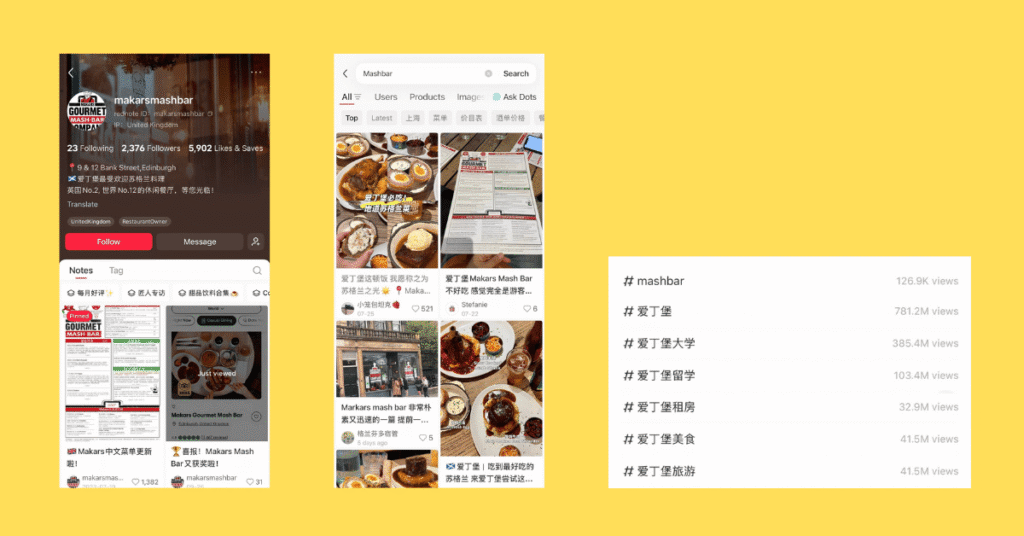
After that, the owners did two things: they prepared a Chinese menu and opened their own official Rednote account. The account works as a promotion channel, and its posts help Chinese consumers understand the restaurant's history, culture and signature dishes, giving potential visitors a better sense of the experience before they arrive.
Rednote word of mouth can directly influence where Chinese tourists spend their money, with no ad spend at all. The same applies to restaurants, hotels, attractions and shops that depend on tourists: Chinese visitors search notes before a trip, post notes after they visit, and a venue's exposure keeps going round. The same logic works for brands selling into China: users discover a product through notes, check it by searching, then decide whether to buy.
Case 2: Jellycat, a brand Chinese consumers "played" into popularity
Jellycat took a very different route to popularity in China. It didn't start with ads and build word of mouth later. Consumers started playing with it first. On Rednote, most Jellycat content comes from ordinary users. They show off their plush toys, create memes, photograph them in different settings and turn them into characters with their own personalities and stories. The brand didn't set any of this up. Users came up with it themselves. Over time, Jellycat stopped being just an overseas plush toy brand and became something people share, talk about and remix.
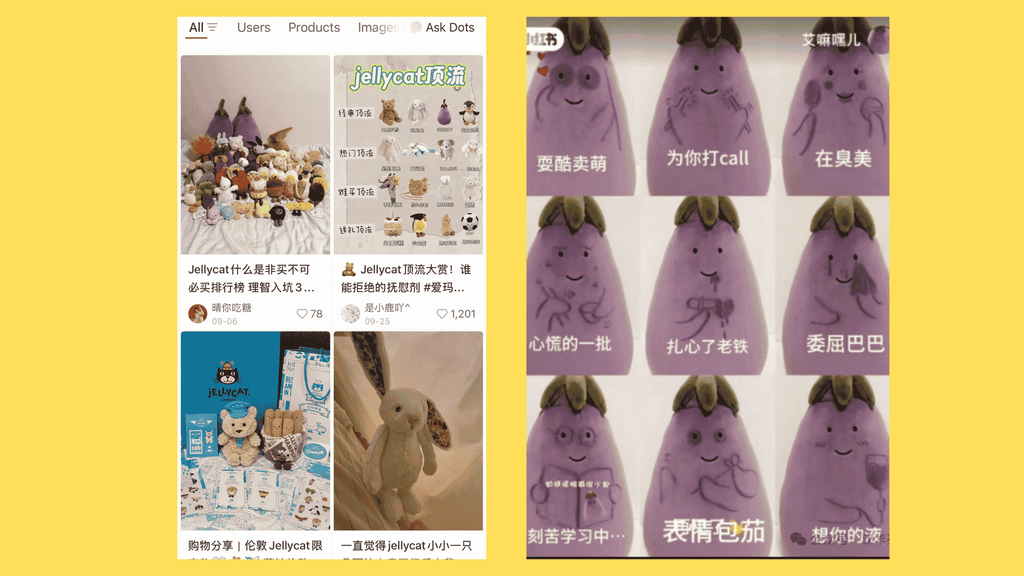
The numbers illustrate just how consumer-led the conversation has been. Xiaohongshu is an important platform for Jellycat's presence in China: more than 96% of related content is UGC, while Rednote accounts for 64% of the overall content share. In other words, much of the conversation was not created through paid advertising. Consumers created it themselves.
So for overseas brands, Rednote is more than a place to advertise. When consumers are willing to create content on their own, a brand gets more than exposure. It gets people who want to take part, talk about it, and even reinterpret what the brand means.
Xiaohongshu isn't a cure-all
That does not mean Xiaohongshu is the answer for every overseas brand. There are some important limitations to keep in mind:
- Content needs to be localised. Simply translating overseas content into Chinese rarely works. The content needs to reflect how Chinese users communicate, what they care about and how they would actually use the product.
- The platform has its own rules. Brands need to understand Xiaohongshu's content and advertising policies before they start publishing or promoting content.
- Building momentum takes time. A successful presence usually comes from consistently creating and refining content rather than relying on a handful of posts.
How a brand can get started
- Search first, then decide. Search your category on Xiaohongshu and see what Chinese users are talking about, and what they expect from and complain about in similar products.
- Start with one niche category or audience. There's no need to cover the whole country at once. Focus on the group that fits best.
- Test on a small scale. Use creator partnerships and a handful of notes to test your product, price and selling points, adjust based on feedback, then decide whether to put in more.
In short
For an overseas brand with no profile in China, Rednote works like a low-cost testing ground: let Chinese consumers see you and talk about you first, then decide how much more to invest. For businesses that rely on tourists, it's a way to get Chinese visitors to put you on their itinerary before they leave. That doesn't mean other platforms don't matter. When resources are limited at the start, beginning with Xiaohongshu is often the safer first step.
Want to promote your products on Xiaohongshu?
Rednote's popularity has already given many international brands a boost, and the potential of Chinese consumers is huge. If you don't know how to get started on the platform, get in touch for a free consultation.
Harmix 've helped brands grow from zero to one, guiding them through Rednote so they can succeed in the China market. Chinese consumers are waiting to meet your brand.